How to read the ingredient list on the back of a bottle
The small print on the back is the most honest part of any skincare product. What the order tells you, and how to find the water, preservative and fragrance.
Koziva · · 5 min read
The front of a skincare bottle is where a brand gets to talk. The back is where the formula has to speak for itself. That long line of small print, usually in a font size nobody enjoys, is the full ingredient list, and once you know a few rules it tells you more than any tagline.
You do not need a chemistry degree. You need to know how the list is ordered, where that order stops being useful, and which few words to look for.
The names are standardised, mostly
Ingredient lists use a shared naming system called INCI, the International Nomenclature of Cosmetic Ingredients. The point is that the same ingredient has the same name on a bottle made in Seoul, Paris or Delhi, so you can compare products without guessing. That is why you see Latin plant names like Butyrospermum Parkii for shea butter, or Betula Alba for birch.
Brands sometimes add the common name in brackets to help, which is what we do on the Birch Sap Moisturiser: "Butyrospermum Parkii (Shea Butter)". When a name means nothing to you, searching it with the word "INCI" usually finds a plain explanation quickly.
“The front of the bottle is the brand talking. The back is the formula.”
The order is the most useful thing on the label
Ingredients are listed from the largest amount to the smallest. The rule most labels are written to comes from the EU's cosmetics regulation, Regulation (EC) No 1223/2009, which asks for ingredients in descending order of weight at the time they are added.
That makes the first few names the ones that really shape the product. In most creams, serums and toners the first ingredient is water. That is not a trick or a filler. Water is what carries everything else, keeps a toner light enough to spray and lets a serum spread across your face in a thin layer.
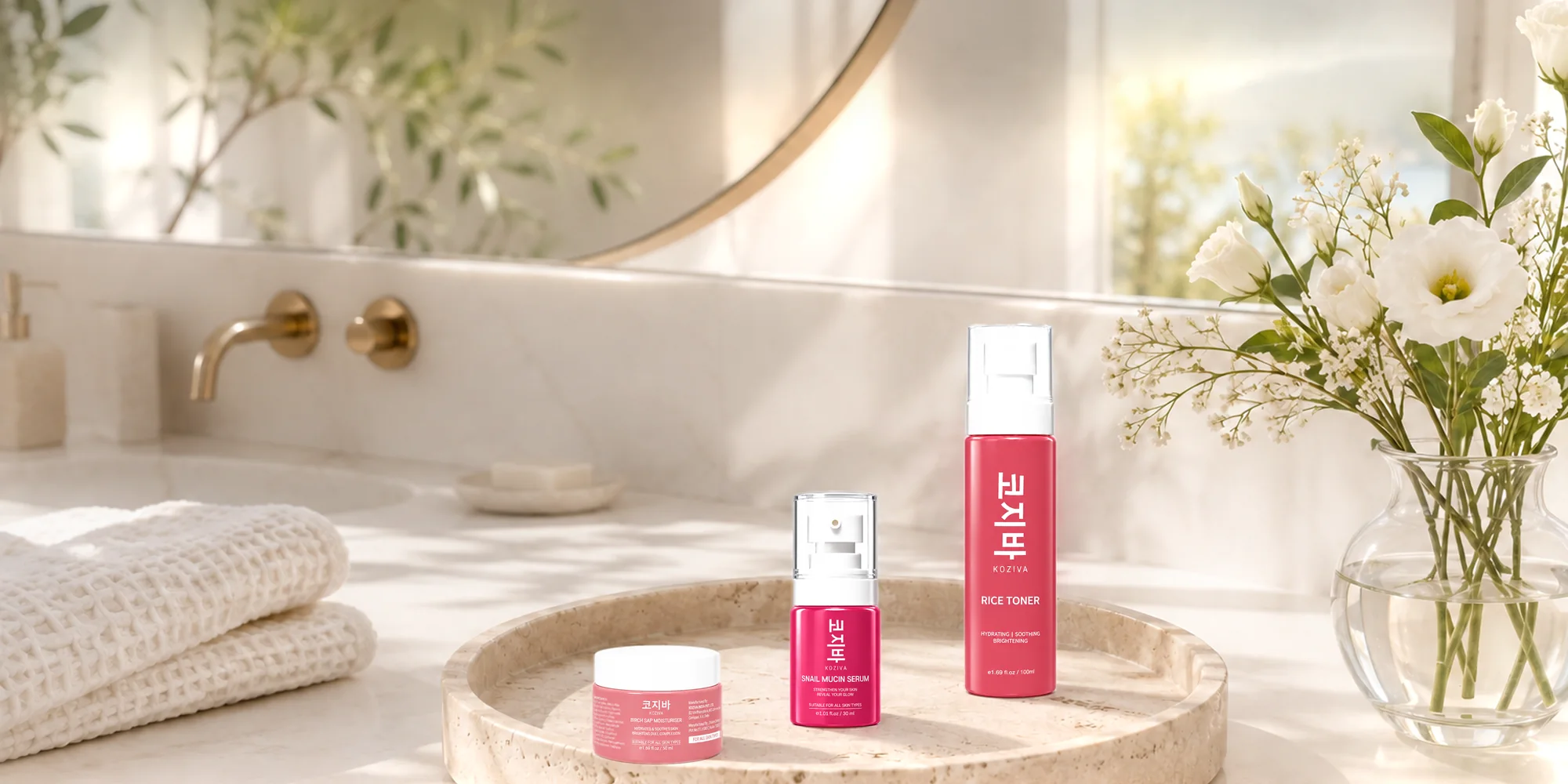
What comes straight after the water is the thing to read closely. On our Rice Toner the second ingredient is Rice Ferment Filtrate. On the Snail Mucin Serum it is Snail Secretion Filtrate. On the moisturiser it is the birch sap extract. That is what a product named after an ingredient should look like: the ingredient on the front, near the top of the list on the back.
If a product is named after something you only find at the very end of its list, that tells you something too.
Where the order stops telling you much
The same regulation allows one exception, and it matters. Ingredients present at less than 1% can be listed in any order after the ones above 1%. So the tail end of a list is not a ranking. An extract listed fourth from the end is not necessarily present in a smaller amount than the one listed sixth from the end.
There is no line on the label that marks where 1% falls. A rough landmark many label readers use is the preservative, because the common ones are used at low levels. Phenoxyethanol, for example, is limited to a maximum of 1% in the EU. Anything after it is in the small-amount part of the list, where the order is free.
Small amounts are not a bad sign on their own. Plenty of ingredients do their work at low levels, and some would be unpleasant or unstable at high ones. What the 1% rule really tells you is to be careful about reading the bottom half of a list as a league table.
Three words worth finding every time
The preservative. Anything that contains water needs protection from the bacteria and mould that would otherwise grow in it after you open it. On our labels that is Phenoxyethanol, and in the serum and moisturiser it is paired with Ethylhexylglycerin, which helps it work. A water-based product with no preservative is not "cleaner"; it is a product that needs to be used up very quickly or kept cold. If you see a preservative, that is the formula doing its job.
The fragrance. Fragrance is usually listed as one word, "Fragrance" or "Parfum", even though it can be a blend of many materials. If your skin reacts easily to scented products, this is the first word to look for. Our Rice Toner has no fragrance in its list; the serum and moisturiser do, at the end.
The chelating agent. Disodium EDTA is on our toner and serum labels, and on many others. It binds to metal ions, the kind that come with hard tap water and can make a formula less stable over time. It is one of those ingredients that sounds alarming and does something dull and useful.
What the list cannot tell you
An ingredient list is honest, but it is not complete information.
It does not give percentages. Two products can share the same first five ingredients and feel completely different, because the amounts, the grade of each raw material and the way the formula was made are not on the label.
It does not tell you how a product will suit your skin. That only comes from using it. If you are trying something new, especially something with fragrance, put a little on a small patch of skin, such as the side of the neck or inside the forearm, for a few days before it goes on your whole face.
And it does not tell you whether a product is good. A short list is not automatically gentler, a long list is not automatically better, and an ingredient you cannot pronounce is not automatically worse than one you can. Most of the work is done by the first few names and by how well they were put together.
A two-minute habit
Next time you pick up something new, turn it over before you read the front. Find the first three ingredients, find the preservative, check for the word fragrance. That is enough to know what you are actually buying.
Every Koziva product page lists the full ingredients, copied from the back label, so you can do exactly this before you order. If you want to see how the three fit together, the ritual walks through each step in order.
Keep reading